
Shkoosh is easy to learn, fast to play, and built for pure competitive fun.
On this page, we’ll walk you through the basics. From setting up the field to mastering your shots, so you can start playing in just minutes. You’ll also find the full rulebook and a 'How to Play' video below for an even quicker start. Our tip is to turn on the subtitles!
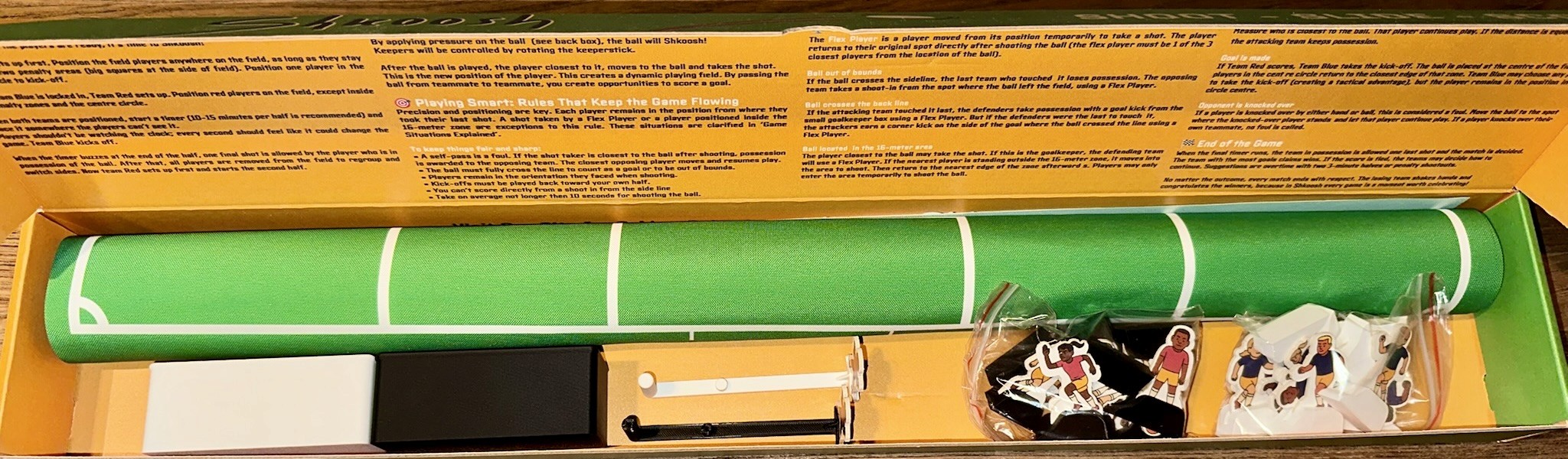
Whats in the Box?
Crack it open and hit the pitch. Shkoosh is easy to play straight out of the box.
Inside this box, you’ll find everything you need to play your first Shkoosh match:
- 1 Playing field
- 2 Goals
- 2 Bags containing the two different sizes of white and black feet
- 1 Cardboard containing the blue and red teams
- 6 Playing balls, 2 red, 2 white and 2 blue
- 1 Ruler
⚽ Kick-Off: Let the Game Begin
The field is set, the players are ready, it’s time to Shkoosh!
Team Blue sets up first. Position the field players anywhere on the field, as long as they stay out of the two penalty areas (squares at the side of field). Position one player in the centre circle to kick-off.
Once team blue is locked in, Team Red sets up. Position red players on the field, except inside the penalty zones and the centre circle.
When both teams are positioned, start a timer (10-15 minutes per half is recommended) and place it somewhere the players can’t see it. All players shouldn't be watching the clock; every second should feel like it could change the game. Team blue kicks off.
When the timer buzzes at the end of the half, one final shot is allowed by the player who is in possession of the ball. After that, all players are removed from the field to regroup and switch sides. Now Team Red sets up first and starts the second half.
⚡ Gameplay: Slide Into Action
By applying pressure on the ball the ball will Shkoosh! Keepers will be controlled by rotating the keeperstick.
After the ball is played, the player closest to it moves to the ball and takes the shot. This is the new position of the player. This creates a dynamic playing field. By passing the ball from teammate to teammate, you create opportunities to score a goal.
Throughout the match, control the goalkeeper to block incoming shots.
🎯 Playing Smart: Rules That Keep the Game Flowing
Precision and positioning are key. Each player remains in the position from where they took their last shot. A shot taken by a Flex Player or a player positioned inside the 16-meter zone are exceptions to this rule. These situations are clarified in ‘Game Situations Explained’.
To keep things fair and sharp:
A self-pass is a foul. If the shot taker is closest to the ball after shooting, possession is awarded to the opposing team. The closest opposing player resumes play.
The ball must fully cross the line to count as a goal or to be out of bounds. If not, the game continues.
Players remain in the orientation they faced when shooting.
Kick-offs must be played back toward your own half.
Kick-offs and shoot-ins from the side line are indirect, you can’t score directly from them.
Take on average not longer then 10 seconds for shooting the ball.
⚖️ Game Situations Explained
The Flex Player is a player moved from its position temporarily to take a shot. The player returns to their original spot directly after shooting the ball (the flex player must be 1 of the 3 closest players from the location of the ball).
Ball out of bounds
If the ball crosses the sideline, the last team who touched it loses possession. The opposing team takes a shoot-in from the spot where the ball left the field, using a Flex Player.
Ball crosses the back line
If the attacking team touched it last, the defenders take possession with a goal kick from the small goalkeeper box using a Flex Player. But if the defenders were the last to touch it, the attackers earn a corner kick on the side of the goal where the ball crossed the line using a Flex Player.
Ball located in the 16-meter area
The player closest to the ball may take the shot. If this is the goalkeeper, the defending team will use a Flex Player. If the nearest player is standing outside the 16-meter zone, it moves into the area to shoot. Then return to the nearest edge of the zone afterwards. Players may only enter the area temporarily to shoot the ball.
Ball located between two players
Measure who is closest to the ball. That player continues play. If the distance is equal, the attacking team keeps possession.
Goal is made
If Team Red scores, Team Blue takes the kick-off. The ball is placed at the centre of the field. Any players in the centre circle return to the closest edge of that zone. Team Blue may choose any player to take the kick-off (creating a tactical advantage), but the player remains in the position in the circle centre.
Opponent is knocked over
If a player is knocked over by either hand or ball, this is considered a foul. Move the ball to the spot where the knocked-over player stands and let that player continue play. If a player knocks over their own teammate, no foul is called.
🏁 End of the Game
When the final timer runs, the team in possession is allowed one last shot and the match is decided.
The team with the most goals claims wins. If the score is tied, the teams may decide how to continue. Suggestions are overtime with two 3-minute halves or penalty shootouts.
No matter the outcome, every match ends with respect. The losing team shakes hands and congratulates the winners, because in Shkoosh every game is a moment worth celebrating!
Whats in the Box?
Crack it open and hit the pitch. Shkoosh is easy to play straight out of the box.
Inside this box, you’ll find everything you need to play your first Shkoosh match:
- 1 Playing field
- 2 Goals
- 2 Bags containing the two different sizes of white and black feet
- 1 Cardboard containing the blue and red teams
- 6 Playing balls, 2 red, 2 white and 2 blue
- 1 Ruler
⚽ Kick-Off: Let the Game Begin
The field is set, the players are ready, it’s time to Shkoosh!
Team Blue sets up first. Position the field players anywhere on the field, as long as they stay out of the two penalty areas (squares at the side of field). Position one player in the centre circle to kick-off.
Once team blue is locked in, Team Red sets up. Position red players on the field, except inside the penalty zones and the centre circle.
When both teams are positioned, start a timer (10-15 minutes per half is recommended) and place it somewhere the players can’t see it. All players shouldn't be watching the clock; every second should feel like it could change the game. Team blue kicks off.
When the timer buzzes at the end of the half, one final shot is allowed by the player who is in possession of the ball. After that, all players are removed from the field to regroup and switch sides. Now Team Red sets up first and starts the second half.
⚡ Gameplay: Slide Into Action
By applying pressure on the ball the ball will Shkoosh! Keepers will be controlled by rotating the keeperstick.
After the ball is played, the player closest to it moves to the ball and takes the shot. This is the new position of the player. This creates a dynamic playing field. By passing the ball from teammate to teammate, you create opportunities to score a goal.
Throughout the match, control the goalkeeper to block incoming shots.
🎯 Playing Smart: Rules That Keep the Game Flowing
Precision and positioning are key. Each player remains in the position from where they took their last shot. A shot taken by a Flex Player or a player positioned inside the 16-meter zone are exceptions to this rule. These situations are clarified in ‘Game Situations Explained’.
To keep things fair and sharp:
A self-pass is a foul. If the shot taker is closest to the ball after shooting, possession is awarded to the opposing team. The closest opposing player resumes play.
The ball must fully cross the line to count as a goal or to be out of bounds. If not, the game continues.
Players remain in the orientation they faced when shooting.
Kick-offs must be played back toward your own half.
Kick-offs and shoot-ins from the side line are indirect, you can’t score directly from them.
Take on average not longer then 10 seconds for shooting the ball.
⚖️ Game Situations Explained
The Flex Player is a player moved from its position temporarily to take a shot. The player returns to their original spot directly after shooting the ball (the flex player must be 1 of the 3 closest players from the location of the ball).
Ball out of bounds
If the ball crosses the sideline, the last team who touched it loses possession. The opposing team takes a shoot-in from the spot where the ball left the field, using a Flex Player.
Ball crosses the back line
If the attacking team touched it last, the defenders take possession with a goal kick from the small goalkeeper box using a Flex Player. But if the defenders were the last to touch it, the attackers earn a corner kick on the side of the goal where the ball crossed the line using a Flex Player.
Ball located in the 16-meter area
The player closest to the ball may take the shot. If this is the goalkeeper, the defending team will use a Flex Player. If the nearest player is standing outside the 16-meter zone, it moves into the area to shoot. Then return to the nearest edge of the zone afterwards. Players may only enter the area temporarily to shoot the ball.
Ball located between two players
Measure who is closest to the ball. That player continues play. If the distance is equal, the attacking team keeps possession.
Goal is made
If Team Red scores, Team Blue takes the kick-off. The ball is placed at the centre of the field. Any players in the centre circle return to the closest edge of that zone. Team Blue may choose any player to take the kick-off (creating a tactical advantage), but the player remains in the position in the circle centre.
Opponent is knocked over
If a player is knocked over by either hand or ball, this is considered a foul. Move the ball to the spot where the knocked-over player stands and let that player continue play. If a player knocks over their own teammate, no foul is called.
🏁 End of the Game
When the final timer runs, the team in possession is allowed one last shot and the match is decided.
The team with the most goals claims wins. If the score is tied, the teams may decide how to continue. Suggestions are overtime with two 3-minute halves or penalty shootouts.
No matter the outcome, every match ends with respect. The losing team shakes hands and congratulates the winners, because in Shkoosh every game is a moment worth celebrating!
⚽ Kick-Off: Let the Game Begin
The field is set, the players are ready, it’s time to Shkoosh!
Team Blue sets up first. Position the field players anywhere on the field, as long as they stay out of the two penalty areas (squares at the side of field). Position one player in the centre circle to kick-off.
Once team blue is locked in, Team Red sets up. Position red players on the field, except inside the penalty zones and the centre circle.
When both teams are positioned, start a timer (10-15 minutes per half is recommended) and place it somewhere the players can’t see it. All players shouldn't be watching the clock; every second should feel like it could change the game. Team blue kicks off.
When the timer buzzes at the end of the half, one final shot is allowed by the player who is in possession of the ball. After that, all players are removed from the field to regroup and switch sides. Now Team Red sets up first and starts the second half.
⚡ Gameplay: Slide Into Action
By applying pressure on the ball the ball will Shkoosh! Keepers will be controlled by rotating the keeperstick.
After the ball is played, the player closest to it moves to the ball and takes the shot. This is the new position of the player. This creates a dynamic playing field. By passing the ball from teammate to teammate, you create opportunities to score a goal.
Throughout the match, control the goalkeeper to block incoming shots.
🎯 Playing Smart: Rules That Keep the Game Flowing
Precision and positioning are key. Each player remains in the position from where they took their last shot. A shot taken by a Flex Player or a player positioned inside the 16-meter zone are exceptions to this rule. These situations are clarified in ‘Game Situations Explained’.
To keep things fair and sharp:
A self-pass is a foul. If the shot taker is closest to the ball after shooting, possession is awarded to the opposing team. The closest opposing player resumes play.
The ball must fully cross the line to count as a goal or to be out of bounds. If not, the game continues.
Players remain in the orientation they faced when shooting.
Kick-offs must be played back toward your own half.
Kick-offs and shoot-ins from the side line are indirect, you can’t score directly from them.
Take on average not longer then 10 seconds for shooting the ball.
⚖️ Game Situations Explained
The Flex Player is a player moved from its position temporarily to take a shot. The player returns to their original spot directly after shooting the ball (the flex player must be 1 of the 3 closest players from the location of the ball).
Ball out of bounds
If the ball crosses the sideline, the last team who touched it loses possession. The opposing team takes a shoot-in from the spot where the ball left the field, using a Flex Player.
Ball crosses the back line
If the attacking team touched it last, the defenders take possession with a goal kick from the small goalkeeper box using a Flex Player. But if the defenders were the last to touch it, the attackers earn a corner kick on the side of the goal where the ball crossed the line using a Flex Player.
Ball located in the 16-meter area
The player closest to the ball may take the shot. If this is the goalkeeper, the defending team will use a Flex Player. If the nearest player is standing outside the 16-meter zone, it moves into the area to shoot. Then return to the nearest edge of the zone afterwards. Players may only enter the area temporarily to shoot the ball.
Ball located between two players
Measure who is closest to the ball. That player continues play. If the distance is equal, the attacking team keeps possession.
Goal is made
If Team Red scores, Team Blue takes the kick-off. The ball is placed at the centre of the field. Any players in the centre circle return to the closest edge of that zone. Team Blue may choose any player to take the kick-off (creating a tactical advantage), but the player remains in the position in the circle centre.
Opponent is knocked over
If a player is knocked over by either hand or ball, this is considered a foul. Move the ball to the spot where the knocked-over player stands and let that player continue play. If a player knocks over their own teammate, no foul is called.
🏁 End of the Game
When the final timer runs, the team in possession is allowed one last shot and the match is decided.
The team with the most goals claims wins. If the score is tied, the teams may decide how to continue. Suggestions are overtime with two 3-minute halves or penalty shootouts.
No matter the outcome, every match ends with respect. The losing team shakes hands and congratulates the winners, because in Shkoosh every game is a moment worth celebrating!
Game Rules

How to Play
